





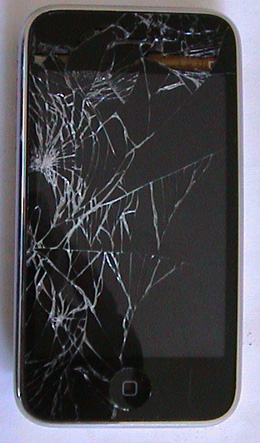
People send me their iPhones from different parts of the world to be repaired. I understand these are a cardinal method of communication for them and I get the repair done and the iPhone back on it's way to them the same day, with no exceptions ... unless it's a water exposure case
iPhones like iPods are as slippery as a wet bar of soap and people are damaging them all the time from dropping them.
When you break them, you have three choices.
I need to teach you about the relevant parts that may be broken on your iPhone. All the parts that make up the screen and finger touch experience are known as the "Display Assembly".
The "Display Assembly" is made up of four parts. the upper glass, the digitizer (both of those are laminated together to make one piece), the LCD and a steel reinforced plastic chassis or "bezel". The Display Assembly bezel with the other parts in it form a complete unit that presents information and receives input from your finger.
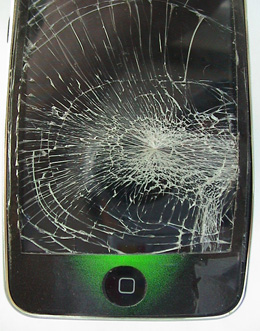
The Upper Glass and Digitizer are fused together using a clear liquid adhesive. The upper glass is what your finger actually touches and shields the iPhone from most of the 'outside world'. The digitizer is glued/fused to the bottom of the upper glass. The digitizer is what interprets finger movements relative to the color information presented below it by the LCD. The upper glass/digitizer are a single piece that is typically what breaks when the phone is dropped and the there is 'breakage' on the surface. When the upper glass is broken, you can usually still use the iPhone, and its Touch sensitive interface it just looks bad.
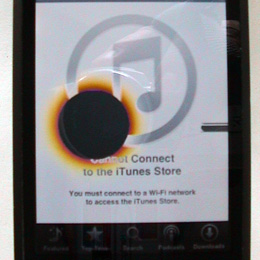
The Liquid Crystal Display or LCD is beneath the digitizer. It is bolted into an exact position so it *and* the digitizer work perfectly together. The LCD shows the icons and your file information, (songs, photos video... games) and the digitizer positioned properly will allow your finger to find and work the screen. When an LCD is broken, you will notice hairline fractures in the color display, sometimes horizontal dark lines, or a "bleed" which is a big splotch in the screen. An LCD bleed can look like a circle or a dark river. In some very rare cases an LCD will fail to an "all white" screen. On that case the backlight is on and no data is painting to the screen. In that "White Out" case the LCD needs to be replaced, it will never work again.
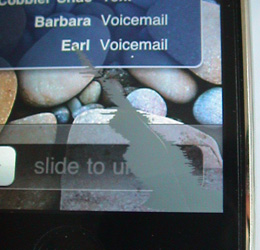
Figure right: This is what a cracked LCD might look like in your case,
There is also another LCD failure type known as a "white out", which occurs when the phone is dropped and one or more of the resistors that drive the LCD's "screen paint" breaks away from the resistor pack that delivers the final color signal to the LCD. The LCD in this case is completely "white", the backlight works perfectly, but the color information isn't presented.
The Upper Glass/Digitizer is replaceable as a single part in the iPhone 3G and 3GS.
The LCD is also replaceable as a single part in the iPhone 3G and 3GS.
Only *very* rarely (when something has fallen onto and through the upper glass) do you need both replaced at the same time.
Pricing for the upper glass/screen repair for the 3 series models is located here. I also include the pricing if you want to have your battery replaced at the same time. That "plus battery" column is to the right of the screen replacement column.
If you have an iPhone 4/4S the display assembly is a more elaborate and expensive problem.....
Pricing for the upper glass/screen repair for the 4 series models is located here. I also include the pricing if you want to have your battery replaced at the same time. That "plus battery" column is to the right of the screen replacement column.
Let's get some distressing news, about the iPhone 4 series out of the way.
I *do* replace the smashed front screens on iPhone 4 models. The replacement takes about 45 minutes, considerably longer than the 3G and 3GS. It is also considerably more expensive.
The iPhone 4 has a few things going on that may not be obvious when you get it.
1)The Retina Display introduces some problems. The display has 4 times more resolution than the 3G/3GS. In order to make it operate correctly Apple had to make the digitizer line up over the LCD perfectly, on a pixel for pixel basis. If they weren't lined up perfectly then the instance of you getting the "D" instead of the "S" would be even greater than it is already.
To make the digitizer (which interprets finger movement) line up perfectly over the LCD so mistakes are minimized, Apple had the Upper Glass (the part your finger touches), the digitizer (the part that interprets finger movement on the upper glass) and LCD screen (which displays the color information you interact with... apps/icons) all glued together.
Because those parts have to all be replaced together, the "screen repair" (which in the 3G/3GS meant upper glass and digitizer only) is much more expensive.
Also the glued together "retina display" cuts manufacturing costs. In the 3 series 6 tiny screws and double sided thermal tape held the parts together. That actually allowed any of the pieces to be replaced singly. It also meant a lot more time was used to build that sub-assembly, I don't even think the 3 series display assemblies could be built by machine. However the 4 series displays are easily blown out by machine. You need to remember... Apple doesn't have 3rd party "authorized iPhone repair dealers" anymore than they have "authorized iPod" or "authorized iPad" repair dealers. ( Apple being the first party, you being the second party and me or an Apple dealer being the 3rd party. With iOS products, they are sent to Apple for repair... and no where else. And that is only if they are under warranty still. Apple doesn't manage repairs for any devices not still under Apple Care (warranty).
In the case of a phone that needs repair, you are handed or sent a new one. They may call it refurbished but it isn't. They use the term refurbished to infer it being a lesser model and so they don't have to explain why they have perfectly new but out of date models on hand for people.
Since Apple doesn't repair returned phones (they are destroyed, or they are palletized, sent out of the country where they can be resold provided they aren't sold back in the US thereby cannibalizing a new iPhone transaction. ) choosing to use a single part to save labor fits into the broader income stream.
2)The other thing not obvious about the i4 is that it uses tempered glass on the front and back of the phone. Fire tempered glass is designed to break and then crumble away making the need to replace the broken glass more acute than the earlier 3G/3GS. In those models the device would work for quite a while with a crack in it. The new i4 model has glass that begins to fall out after being smashed.
3)The i4 has been calculated, (because of the way it's constructed with a cold forged, NC milled metal frame, and tempered glass front and back) to be 5 times more likely to break the front glass in a casual drop than the 3GS.
If you were thinking of waiting for the i5 to come out next September 12th.... you're smarter than 165 million people who have already got the i4/i4S. The i5 is already reported to have a new look and form factor, wait for it if you can.
You can either bring or send your iPhone to me.
Here is how to bring your iPhone in.
Here is how to send your iPhone in.
More on methods of payment is here:
http://www.isickbay.com/payments.shtml
These are comments people have sent me after they received their iPod back fixed.
http://www.isickbay.com/comments/comments.shtml
My most complex iPhone water case ever
http://www.isickbay.com/call--1-877-IPOD-PRO/recent_fixes/recent_fixes_497.shtml
Frank Walburg
2145 Service Court
Santa Rosa, Ca 95403-3139